
Join our AllAirCooled VWs Facebook group to connect with other Vintage VW enthusiasts!
A curated set of rare Volkswagen factory images showing Beetle, Bus, Ghia, and Type 3 production from the 1940s to the 1970s across historic VW plants.
 February 2025 marks the closure of the Audi Brussels plant in Forest after
nearly 77 years of vehicle production. Originally opened by D’Ieteren
in 1948, the factory assembled Studebakers before shifting to Volkswagen
Beetle production in 1954, operating with 750 workers building about 75
cars per day.
February 2025 marks the closure of the Audi Brussels plant in Forest after
nearly 77 years of vehicle production. Originally opened by D’Ieteren
in 1948, the factory assembled Studebakers before shifting to Volkswagen
Beetle production in 1954, operating with 750 workers building about 75
cars per day.
 This story marks Volkswagen Brazil’s celebration of one million locally
built Beetles by finding the oldest surviving Brazilian-made car. The
winner, Marina Ferreira de Camargo Gabas, owned the 49th Beetle produced
in 1959 and received the millionth unit, a green 1500 that remains in
her family today.
This story marks Volkswagen Brazil’s celebration of one million locally
built Beetles by finding the oldest surviving Brazilian-made car. The
winner, Marina Ferreira de Camargo Gabas, owned the 49th Beetle produced
in 1959 and received the millionth unit, a green 1500 that remains in
her family today.
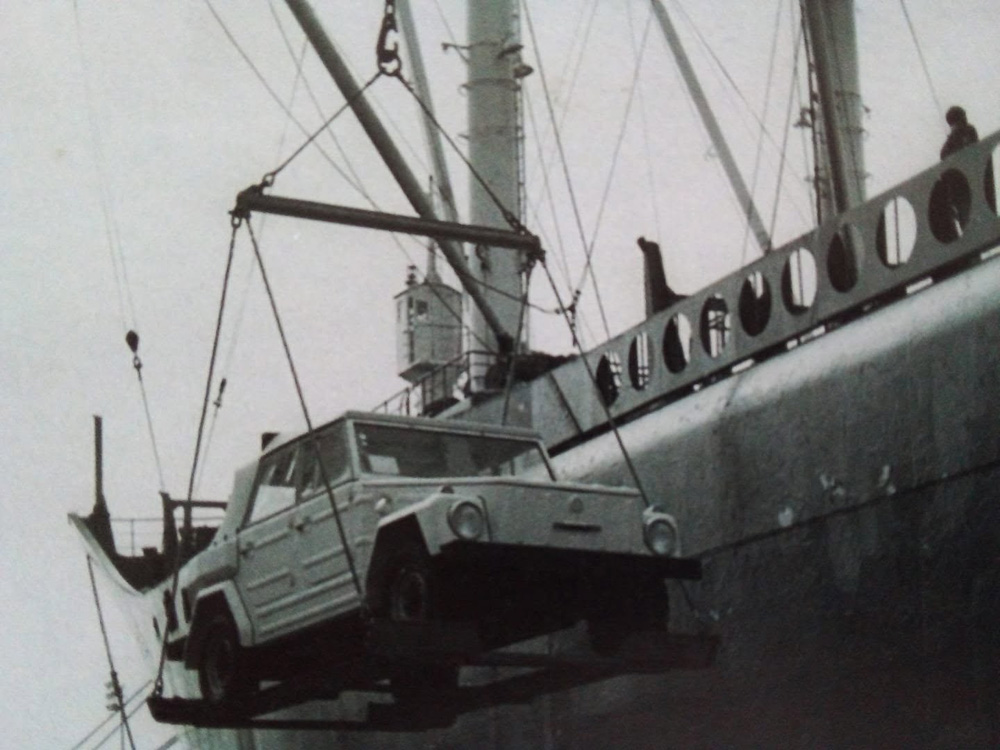
 This
photo shows a new 1967 VW Type 3 Fastback being hoisted aboard a ship
at Emden for export to North America. Hubcaps, wiper arms and the exterior
mirror were stowed inside the car to protect them during the sea crossing.
This
photo shows a new 1967 VW Type 3 Fastback being hoisted aboard a ship
at Emden for export to North America. Hubcaps, wiper arms and the exterior
mirror were stowed inside the car to protect them during the sea crossing.
 This
scene shows new Volkswagens from Puebla being loaded onto a roll-on roll-off
ship at Veracruz for export to Emden in the late 1970s. The large banner
underscores Volkswagen de Mexico’s growing commitment to supplying
vehicles to European markets.
This
scene shows new Volkswagens from Puebla being loaded onto a roll-on roll-off
ship at Veracruz for export to Emden in the late 1970s. The large banner
underscores Volkswagen de Mexico’s growing commitment to supplying
vehicles to European markets.
 Production
line of the VW Type 147 Fridolin. A total of 6,139 vehicles were produced
between 1964-1974, mainly for the German Postal service.
Production
line of the VW Type 147 Fridolin. A total of 6,139 vehicles were produced
between 1964-1974, mainly for the German Postal service.
 The Volkswagen Doppelkabine, known as the Doka or Crew-cab, a Transporter
variant long appreciated by enthusiasts. Note the model’s 65th anniversary
and distinguishes the Volkswagen-built version from earlier coachbuilt
double-cab concepts.
The Volkswagen Doppelkabine, known as the Doka or Crew-cab, a Transporter
variant long appreciated by enthusiasts. Note the model’s 65th anniversary
and distinguishes the Volkswagen-built version from earlier coachbuilt
double-cab concepts.
 This
vintage Volkswagen Type 181 scene shows a large batch of Safaris being
exported from Mexico. It reflects the model’s early production at
Puebla and its growing presence across Central America and Cuba in the
early 1970s.
This
vintage Volkswagen Type 181 scene shows a large batch of Safaris being
exported from Mexico. It reflects the model’s early production at
Puebla and its growing presence across Central America and Cuba in the
early 1970s.
 VW
Bus in two-color paint finish during installation of the interior at Volkswagen
Wolfsburg 1955.
VW
Bus in two-color paint finish during installation of the interior at Volkswagen
Wolfsburg 1955.
 The
body of a 1973 special limited edition 1303 Komfort-Käfer, painted
in Ravenna Green L65K, is lowered onto its chassis for the Hochzeit at
Volkswagenwerk Wolfsburg.
The
body of a 1973 special limited edition 1303 Komfort-Käfer, painted
in Ravenna Green L65K, is lowered onto its chassis for the Hochzeit at
Volkswagenwerk Wolfsburg.
 The
Volkswagen Karmann Ghia, developed in close cooperation with Wilhelm Karmann
GmbH from Osnabrück, has become an icon of elegant sportiness. Production
of this design classic came to an end in 1974 after 485,964 coupés
and convertibles.
The
Volkswagen Karmann Ghia, developed in close cooperation with Wilhelm Karmann
GmbH from Osnabrück, has become an icon of elegant sportiness. Production
of this design classic came to an end in 1974 after 485,964 coupés
and convertibles.
 Painted
bodyshells arrive in a hall at Volkswagen Emden prior to fitting out and
final assembly in 1969. The photo captures a key stage in the production
process, showing freshly finished shells lined up under bright factory
lighting as they await installation of mechanical components and interiors.
Painted
bodyshells arrive in a hall at Volkswagen Emden prior to fitting out and
final assembly in 1969. The photo captures a key stage in the production
process, showing freshly finished shells lined up under bright factory
lighting as they await installation of mechanical components and interiors.
 Konrad Adenauer, the first Chancellor of West Germany, who had been in
post since 1949, made an official visit to the Volkswagenwerk in Wolfsburg
on 22 April 1955. Hosted by Volkswagen Generaldirektor Heinrich Nordoff,
he was given a tour of the factory in a new Volkswagen Cabriolet.
Konrad Adenauer, the first Chancellor of West Germany, who had been in
post since 1949, made an official visit to the Volkswagenwerk in Wolfsburg
on 22 April 1955. Hosted by Volkswagen Generaldirektor Heinrich Nordoff,
he was given a tour of the factory in a new Volkswagen Cabriolet.
 New
Volkswagens arrive from the factory at a German port for export by ship
in 1951. Most of you will be aware that hubcaps and wipers were left inside
the vehicles for the sea crossing - a practice that went on into the late
1970s.
New
Volkswagens arrive from the factory at a German port for export by ship
in 1951. Most of you will be aware that hubcaps and wipers were left inside
the vehicles for the sea crossing - a practice that went on into the late
1970s.
 Type
3 final assembly at Volkswagenwerk Wolfsburg, featured in the December
1970 VW 1600 sales brochure. The photo captures the production line in
full operation, with rows of Type 3 bodies moving through the last stages
of assembly under bright factory lighting. Workers are fitting doors,
inspecting panels and completing interior details as each car nears completion.
Type
3 final assembly at Volkswagenwerk Wolfsburg, featured in the December
1970 VW 1600 sales brochure. The photo captures the production line in
full operation, with rows of Type 3 bodies moving through the last stages
of assembly under bright factory lighting. Workers are fitting doors,
inspecting panels and completing interior details as each car nears completion.
 The
new vehicle departure yard of the Anchieta plant of Volkswagen do Brasil,
located in São Bernardo do Campo, São Paulo, pictured in
1969. As well as many Beetles, there are quite a few box-shaped VW 1600
models too.
The
new vehicle departure yard of the Anchieta plant of Volkswagen do Brasil,
located in São Bernardo do Campo, São Paulo, pictured in
1969. As well as many Beetles, there are quite a few box-shaped VW 1600
models too.
 The Swiss Federal Railways were transferring Volkswagens between Germany
and Switzerland, moving new cars across the border as part of their regular
freight operations. This 1972 photo captures a moment in that process,
with VW models loaded for transport during an era when rail played a major
role in moving vehicles through Europe.
The Swiss Federal Railways were transferring Volkswagens between Germany
and Switzerland, moving new cars across the border as part of their regular
freight operations. This 1972 photo captures a moment in that process,
with VW models loaded for transport during an era when rail played a major
role in moving vehicles through Europe.
 Several
metallic green Beetle bodies sit outside in the sun at the Puebla plant
in 2001, lined up in rows and waiting for assembly. The shells catch the
light, showing off the deep green finish that became one of the signature
colors of the final production years.
Several
metallic green Beetle bodies sit outside in the sun at the Puebla plant
in 2001, lined up in rows and waiting for assembly. The shells catch the
light, showing off the deep green finish that became one of the signature
colors of the final production years.
 The
VW van plant in Hanover is largely mechanized. Machines have relieved
humans of heavy physical labor. This has allowed for increased production
output while simultaneously improving the quality of the product.
The
VW van plant in Hanover is largely mechanized. Machines have relieved
humans of heavy physical labor. This has allowed for increased production
output while simultaneously improving the quality of the product.
 Careful
and meticulous bodywork preparation is essential for the longevity of
the paint finish. The three-layer synthetic resin paint makes every Volkswagen
immune to temperature fluctuations. Our photo shows a VW flatbed truck
undergoing automatic spraying.
Careful
and meticulous bodywork preparation is essential for the longevity of
the paint finish. The three-layer synthetic resin paint makes every Volkswagen
immune to temperature fluctuations. Our photo shows a VW flatbed truck
undergoing automatic spraying.
 Body
presses at the VW Transporter plant in Hanover. A push of a button is
all it takes to set these steel behemoths in motion. Here, the "face"
of the VW Transporter is continuously formed from special sheet metal.
Body
presses at the VW Transporter plant in Hanover. A push of a button is
all it takes to set these steel behemoths in motion. Here, the "face"
of the VW Transporter is continuously formed from special sheet metal.
Images courtesy of Volkswagen Factory Pictures
Join our AllAirCooled VWs Facebook group to connect with other Vintage VW enthusiasts!

All things air-cooled: follow @allaircooledvws on Instagram for your daily dose of Vintage VW!

@allaircooledvws on X for the ultimate celebration of Vintage Volkswagen culture!
Got a question or comment? Drop us a line and we'll get back to you as soon as we can. We're always happy to talk Bugs, Buses and everything in between!